Detect satellite anomalies before they become mission-critical failures. soppo.space uses AI to monitor, predict and respond to anomalies in satellite telemetry - in near real time.
Satellite missions generate massive streams of telemetry data.
We turn this data into early warnings, clear insights and actionable alerts - powered by AI.
Detect anomalies before operators notice them.
Our AI models continuously analyze telemetry data to identify abnormal patterns invisible to rule-based systems.
Turn raw satellite telemetry into mission-saving decisions.
Because losing communication should never be the first sign of a problem.
A mission scenario
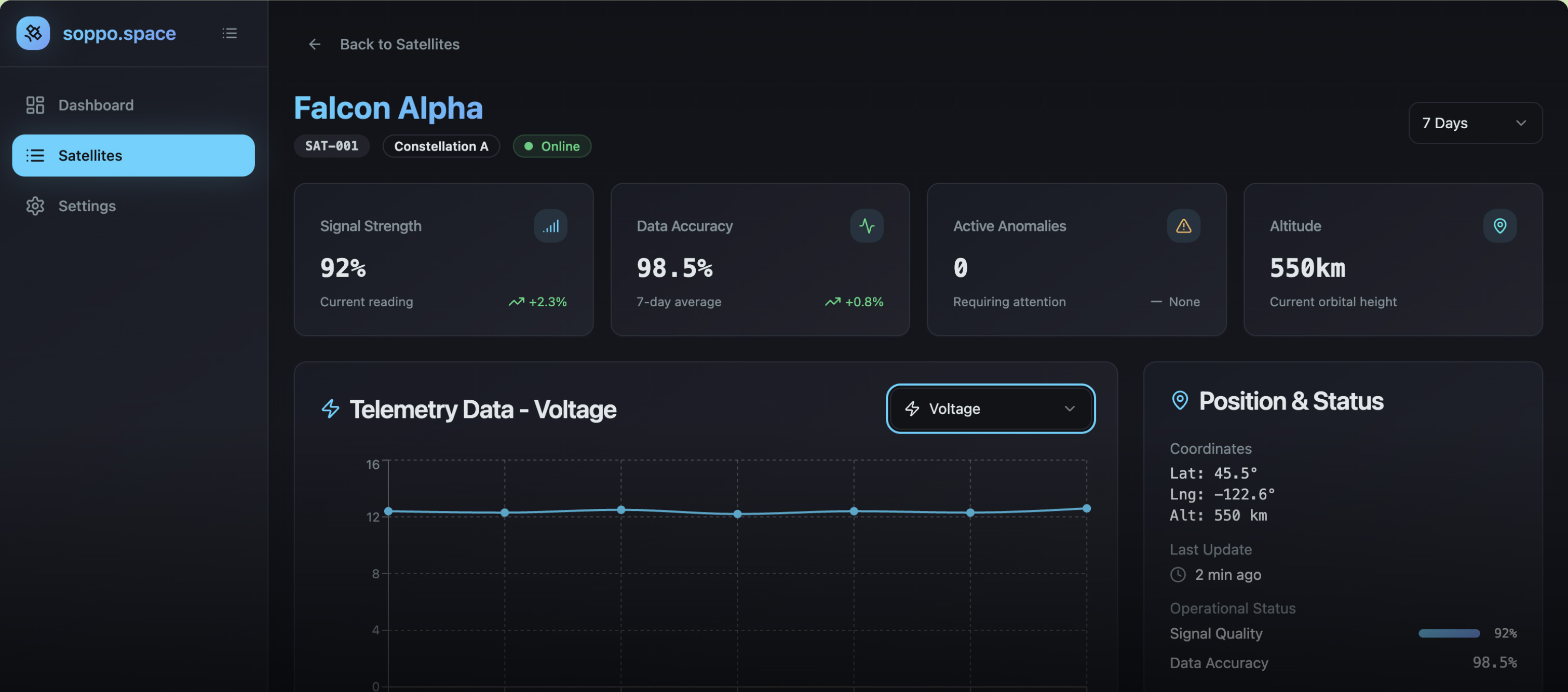
See how SOPPO.Space can help save a satellite mission
LET’S MEET
Get your FREE AI consultation
Unlock your business's true potential with powerful AI tools, integrated into your apps, that streamline tasks, boost efficiency & spark innovation.
ABOUT SOPPO
SOPPO.Space is developed by SOPPO - an experienced technology partner delivering advanced digital systems since 2009.
SOPPO is a European software and data engineering company specializing in complex web and mobile solutions.
For over 15 years, SOPPO has been building high-performance platforms across AI, big data, advanced analytics and real-time dashboards for international clients and R&D-driven organizations.
The SOPPO team combines strong engineering expertise with award-winning design and deep experience in data-intensive environments - from large-scale analytics platforms to predictive systems operating in real time.
SOPPO.Space is a natural extension of SOPPO’s capabilities into the space sector, created in response to real challenges faced by satellite operators, space agencies and research teams.
Have questions?
How does SOPPO.Space handle unknown or previously unseen anomalies?
SOPPO.Space is designed to detect not only known anomalies, but also unknown and emerging patterns.
Instead of relying solely on predefined rules or thresholds, the platform learns normal satellite behavior from telemetry data and identifies deviations in real time. This makes it possible to flag anomalies that have never been observed before — often at a very early stage.
Can SOPPO.Space be adapted to different satellite missions and payload types?
Yes. SOPPO.Space is mission-agnostic by design. The platform can be configured for different satellite architectures, subsystems and payloads by adjusting data models, telemetry inputs and alert logic. This makes it suitable for experimental missions, technology demonstrators, and operational satellites across various orbits and mission profiles.